

DATE
2 September 2026
TEXT
Mick van Biezen
IMAGE
Elise Maaskant
Take a journey through time at the Binnenhof Information Centre
There used to be lions roaming around the Binnenhof. And who knew that The Hague came into being because Count Floris IV bought a farm in the dunes and turned it into a hunting lodge?
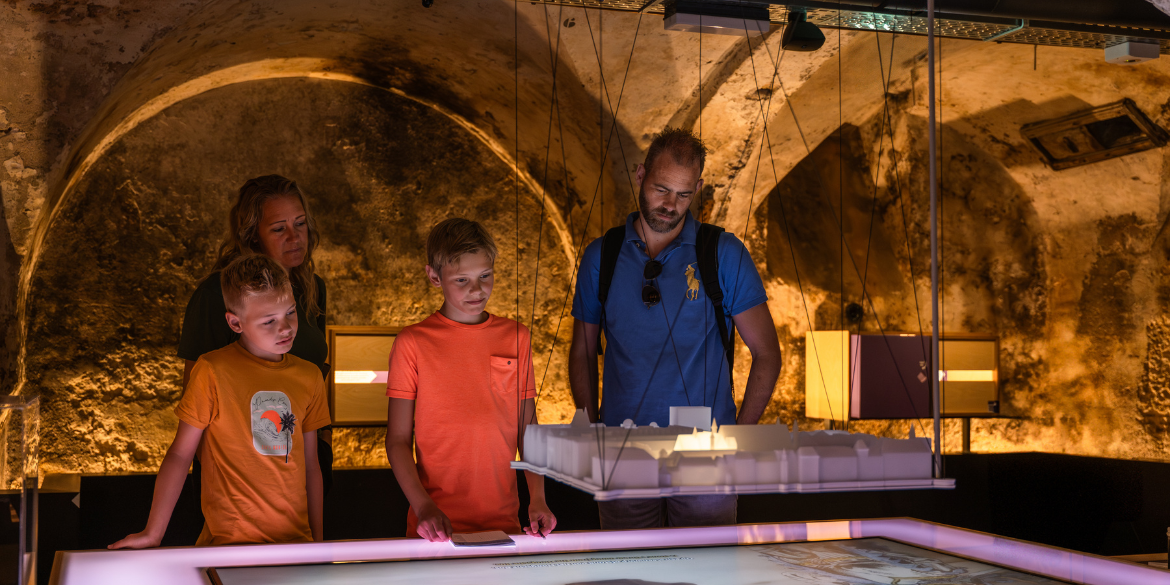
Opposite the Binnenhof, at Plaats 22, stands a 16th-century building – once a luxurious wine merchant’s and a piano shop, now an information centre dedicated to the Binnenhof. You can take a guided tour or explore for yourself how the Binnenhof has evolved since the Middle Ages to become the oldest government centre still in use in the world. The complex is a unique blend of architectural styles spanning eight centuries.
Monique van der Bijl has spent almost her entire working life at and around the Binnenhof. These days she works for the Central Government Property Agency, which is in charge of the renovation. Van der Bijl walks through the information centre, which you could easily call a museum – objects are on display everywhere, the tangible remnants of history. Everyone is welcome here, five days a week. “Look,” she says, “we can go down here by the stairs – or by the lift.”
'Visitors are welcome at the information centre five days a week'
Three generations of counts
On the ground floor, a historic cellar, films, photographs and beautifully illuminated artefacts give you an insight into the origins of the Binnenhof. Van der Bijl points to a golden statue. “This statue of William II used to stand atop the Binnenhof fountain. Thanks to the renovation, visitors can now view the art objects more clearly – up close.”
In the thirteenth century, the area where The Hague now stands was mainly sand. The dunes stretched as far as the eye could see. “Count Floris IV bought a farm in 1229,” says Van der Bijl, “near the Haagse Bos. This farm was then transformed into a hunting lodge, which formed the basis of the Binnenhof, around which The Hague gradually grew.”
The Binnenhof was built by three generations of counts: Floris IV, Willem II and Floris V, all of whom died young in battle. Van der Bijl says: “Whether you’re a Hagenaar or a Hagenees, our city’s history lies here. In the information centre, that history is palpable, visible and tangible.”
Exotic animals
The basement gives you the chance to see how the Dutch lived many centuries ago. For example, the first tennis court in the Netherlands was located at the Binnenhof. A excavated heron’s skull is also on display; in the late Middle Ages, these birds were regarded as a delicacy amongst the nobility. Lion bones – in another display case – are the remains of a (live) gift. As well as lions, other exotic animals could be found at the Buitenhof, such as leopards, dromedaries and monkeys.
Van der Bijl stops to look at a photography exhibition. You learn that the famous turret at the Binnenhof has served various purposes; in the sixteenth century it served as a defensive structure, and later as an inn and wine storehouse. It was not until 1982 that Ruud Lubbers chose the turret as his office, and since then it has been the Prime Minister’s permanent workplace.
“Eight centuries of history,” says Van der Bijl with a touch of amazement. “The Binnenhof has survived it all: the Eighty Years” War, the Kabeljauw disputes, Napoleon’s French rule, and the Second World War.”
'Eight centuries of history, the Binnenhof has weathered it all'
Plans for the future
She walks up the stairs and comes back out onto the ground floor. “On this floor, you can find out more about the Binnenhof today,” says Van der Bijl. “About the various organisations that use the building, and which parts are located where. And look, there are chairs from the Ridderzaal – if you like, you can have a sit on them.”
You can also find out more about the renovation on the ground floor – how the work is being carried out and why it is necessary. “We’re currently working on making the building fit for the future,” says Van der Bijl. “This is urgently needed, as the last major maintenance was carried out almost half a century ago. Everything must meet current standards – lifts, escalators, electrical systems, cabling, Wi-Fi. The Binnenhof must be accessible and safe for everyone who works there and visits. So, in the Information Centre, you’ll find both the past and the plans for the future. In essence, the renovation of the Binnenhof is a continuation of the counts” legacy. I’d say: please feel very welcome here. It’s fantastic to see it all with your own eyes.’
www.binnenhofrenovatie.nl/onderwerpen/informatiecentrum-binnenhof-renovatie